

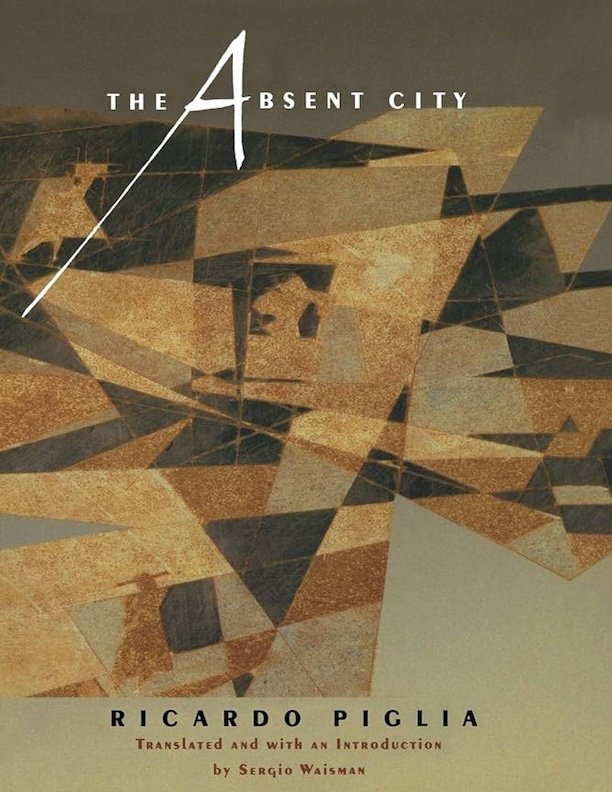
The Absent City by Ricardo Piglia
Closing out our month-long autopsy of the charred remains of Dystopian Cinema, this week’s The Death of Dytopia literary offering is a post-modern excavation of Argentina’s ‘Dirty War’, a crisis period between 1974 to 1983 where General Jorge Rafael Videla’s military junta death squads viciously rooted-out Communists, resulting in the death of over 25,000 political dissidents.
Junior, a Buenos Aires newspaperman, is on-the-hunt for a strange memory machine embedded with the consciousness of a woman named Elena, the deceased wife of a writer who had her memories downloaded onto the device. The military dictatorship sees the device as a threat because the memories it produces are revelations of atrocities perpetrated by the regime.
Rooted in the very-real embattled political history of Argentina, Piglia’s novel utilizes an avant-garde writing style filtered through the spectrum of investigative journalism that shatters the illusion of the then-recent junta’s stranglehold on the truth. Framing the story as essentially a hard-boiled detective novel, Piglia additionally uses the ever-prying eyes of reportage as a navigation device through the city’s violent and oppressive everyday realities.
Piglia in fact worked in magazine and publishing houses for years, championing the works of pulp-heroes Dashiell Hammet and Raymond Chandler before trying his own hand at short story and fiction. Since the publication of his breakthrough novel Respiración artificial (Artificial Respiration) – somehow snuck by the junta censors – in 1980, Piglia has been regarded as one of Latin America’s greatest authors.